

Mostrando entradas con la etiqueta Teja_Ljubljana. Mostrar todas las entradas
Mostrando entradas con la etiqueta Teja_Ljubljana. Mostrar todas las entradas


domingo, 13 de noviembre de 2011
Ljubljana: History
and urbanistic development
First known inhabitants in Ljubljana were
Mostiscarji (lake-dweling people) round 2000 BC.
 |
| Stilt houses from Ljubljana Marshes (Ljubljansko Barje) |
 |
| The oldest wheel in the world, found in Ljubljana marshes from 3200 BC |
Illirians
and Celts were the folowing peoples on this area. Around 50 BC, the Romans
built a military encampment that later became a permanent settlement called
Iulia Aemona – EMONA, which was torn apart by Atila and the Huns.
 |
| Remainings of roman walls |
In the
middle ages the settlers came closer to the hill near todays center of
Ljubljana an started to build a real medieval town.
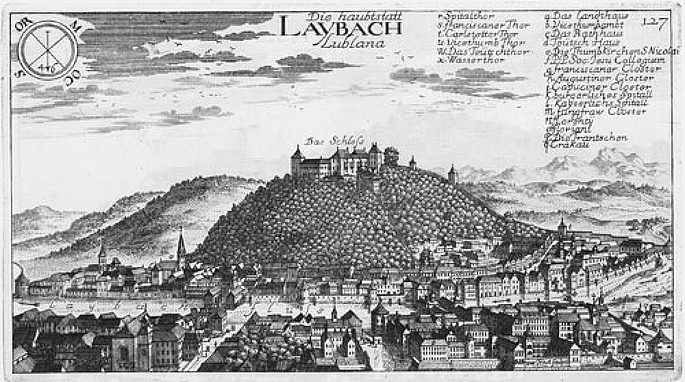
In 1220,
Ljubljana was granted city rights, among others the right to coin its own
money. Craftsmen, who made up the greater part of the city's population, were
organized in craft guilds. In 1270, the city was conquered by the Czech king
Premysl Otakar II, and in 1278 it fell under the Hapsburg rule along with the
rest of the Province of Carniola (Dežela Kranjska).
A rapid
growth of Ljubljana, which was at the time called Laibach, started in the 13th
century, when the town consisted of three town cores: Old Square, Town Square
and New Square. The town was entered by five gates and its three quarters were
connected by two bridges, namely the Lower Bridge and the Upper Bridge, which
later assumed the name of Butchers' Bridge and is currently known as the Cobblers'
Bridge.
In the
15th century, Ljubljana became recognised for its art. After the 1511 earthquake, Ljubljana was
rebuilt in a Baroque style following the model of a Renaissance town; after the
quake in 1895, which severely damaged the city (approximatli 10% of the
buildings were seriously damaged), it was once again rebuilt, this time in a
Vienna Secession style.
The city's architecture is thus a mix of styles. The
large sectors built after the World War II often include a personal touch by
the Slovene architect Jože Plečnik.
 |
| Ljubljana in 1895 after the earthquake |
 |
| Fabiani's urban plan for Ljubljana |
 |
| Plečnik's urban plan for Ljubljana |
In a
study for the regulation of Ljubljana (1929), the architect Jože Plečnik designed
the city of Ljubljana concentrically within the circular road, which he drew on
the edge of town. It included the nearest villages and settlements that were
then near Ljubljana and were intensively growing.
After
the worl war II the first urbanistic document was GUP (General Urbanistic Plan
of Ljubljana), that was exepted in 1966. The base for its preparation were theoretical
studies since the end of World war II. GUP summerized and upraded morphological
model of the town that has been developing trough the centuries. GUP introduced
regulated zoning plan on the whole area and organized infrastructural system.
 |
| GUP |
Plan
LJUBLJANA 2000 was created in the late 80's as a long term plan that included
Ljubljana and its sorounding municipalities. Creators have been thinking about
new recognizable image of the city. It included tram routes new train network
with maintaining important green areas.
 |
| Ljubljana 2000 |
Municipality
of Ljubljana adopted a document in 2002 that constitutes a further development
in the area on the strategic level. The new spatial design guidelines gave the
concept of planned spatial development in the municipality. Determined the
location of the main activities and land use, important systems and particular
transport infrastructure, and protection of heritage and natural and other
resources.
 |
| Ljubljana today |

Ljubjana – objective data


The capital of the Republic of Slovenia, a European member state since 2004
Area: 273 km2
Longitude: 14°30'30'' E
Area: 273 km2
Longitude: 14°30'30'' E
Latitude: 46°03'20'' N
Height above sea level: 298 m
Length of the City of Ljubljana boundary: 137.280 m
Number of residents (1 January 2011): 280.140
Number of students 2009/10: 38,650 (source: Ljubljana University)
Economically active share of the population 2010: 64.5%
Number of unemployed July 2011: 13.765
Average monthly net salary June 2011: €1.119,57
Time zone: GMT + 1/ summer GMT + 2
Postal code: 1000
Climate:
Ljubljana's climate is oceanic, bordering on a humid subtropical climate with continental characteristics such as warm summers and moderately cold winters. July and August are the warmest months with daily highs generally between 25 and 30°C, and January is the coldest month with the temperatures mostly oscillating around 0°C.
Average temperature – January 2010: -1.5° C
Average temperature – July 2010: 22.9° C
Ljubljana's climate is oceanic, bordering on a humid subtropical climate with continental characteristics such as warm summers and moderately cold winters. July and August are the warmest months with daily highs generally between 25 and 30°C, and January is the coldest month with the temperatures mostly oscillating around 0°C.
miércoles, 19 de octubre de 2011
Ljubljana, a people-friendly city
Ljubljana is the political and cultural heart of the Slovenian nation. It is an important European commercial, business, exhibition and congressional centre as well as the transport, science and education centre of Slovenia.

The Republic of Slovenia is a coastal sub-Alpine country in southern Central Europe bordering Italy to the west, the Adriatic Sea to the southwest, Croatia to the south and east, Hungary to the northeast, and Austria to the north.

Slovenia was part of Yugoslavia until gaining independence in 1991.
Slovenia became a member of the European Union on 1 May 2004.
Ljubljana is located in the centre of the country in the Ljubljana Basin and is a mid-sized city of some 270,000 inhabitants. Throughout its history, it has been influenced by its geographic position at the crossroads of the Slavic world with the Germanic and Latin cultures.

Ljubljana is certainly a city with a high quality of life. It is a city of greenery, its very centre occupied by parks and forests, and it also represents an ideal departure point for the discovery of all the variety Slovenia has to offer. The unique Karst region, the Adriatic coast, the mountains, the hilly wine-growing regions, the spas, and many historic towns are all within a two-hour drive.
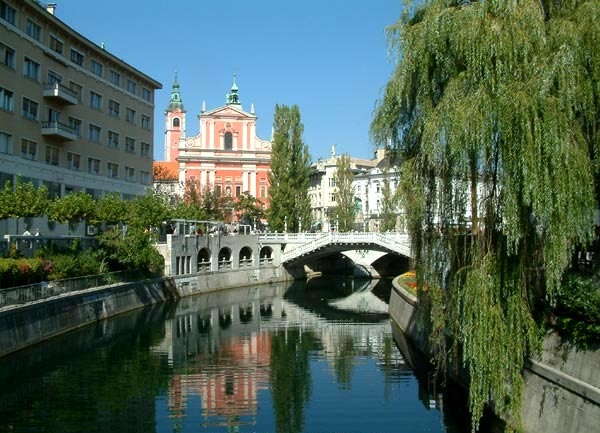
Ljubljanica river in center of Ljubljana

View from above

Dragon, the symbol of Ljubljana
Suscribirse a:
Entradas (Atom)